flowchart LR
  A["<b>Prevention /<br/>mitigation</b>"] --> B["<b>Preparedness</b>"] --> C["<b>Response</b>"] --> D["<b>Recovery</b>"]
5 Crisis Management in Forest-Based Enterprises
For forest enterprises, ‘crisis’ is rarely a single dramatic event. It is more often a slow-building convergence of climate variability, policy or tenure insecurity, and price volatility that erodes an enterprise’s resource base or market access over time. This chapter introduces the basic concepts of crisis management and then examines the crisis profiles of NTFP and community-based enterprises and of timber-based enterprises.
5.1 Foundational concepts
5.1.1 What is crisis management?
Crisis management is the process of preparing for, responding to and recovering from events or conditions that threaten an enterprise’s resources, income or survival. For forest-based enterprises specifically, a crisis is rarely a single dramatic event; it is more often a slow-building convergence of pressures that erodes the enterprise’s resource base or market access over time.
5.1.2 The four stages of crisis management
Crisis management is generally organised around four stages (Figure 5.1):
- Prevention / mitigation: reducing the likelihood or severity of a crisis before it occurs (e.g., diversifying income sources so no single shock is fatal).
- Preparedness: building the systems, awareness and reserves needed to respond quickly if a crisis does occur.
- Response: the immediate actions taken once a crisis has begun, to limit damage.
- Recovery: restoring normal operations and income afterward, ideally in a way that leaves the enterprise less vulnerable to the same crisis next time.
5.1.3 Slow-onset and sudden crises
A useful distinction for forest enterprises is between two kinds of crisis:
- Sudden crises are a single identifiable shock, such as a pandemic-driven collapse in income.
- Slow-onset crises arise where several pressures (policy restriction, weak institutions, price stagnation, climate change) build up gradually and reinforce one another until the enterprise’s resource base or market access is seriously eroded. There is often no single moment that looks like ‘the crisis’ in hindsight.
Teaching point
Most of the forest-sector cases in this chapter are slow-onset crises. This matters for crisis management practice: a slow-onset crisis cannot be managed with the same rapid-response playbook as a sudden shock. It needs sustained monitoring and staged mitigation rather than a single response action.
Discussion questions
- Which of the four crisis-management stages (Section 5.1.2) is hardest to plan for when the crisis itself is slow-onset rather than sudden (Section 5.1.3)?
- Give an example of how one of the four stages could fail even if the other three are well managed.
5.2 Crisis categories across forest enterprises
Four broad crisis categories recur across the case material in this chapter:
- policy and tenure risk;
- institutional and governance fragility;
- price and market volatility; and
- climate change, acting as a threat multiplier across all three.
How exposed a given enterprise is to each category depends heavily on whether it is timber-based or non-timber-based, and on how it is governed.
5.3 Crisis management in NTFP and community-based enterprises
5.3.1 Policy and tenure risk
The Nepal community-based forest enterprise study documents several distinct policy-driven crisis conditions (Pandit et al., 2009):
- Outright restrictions on harvesting or selling certain products despite active demand. For example, the sale of raw yew leaves and spikenard roots was illegal in Nepal at the time of the study, which pushed collectors toward illegal harvesting rather than eliminating demand.
- Export documentation requirements that only registered companies, not Forest User Groups or cooperatives, could obtain. These effectively locked smaller, community-managed enterprises out of higher-value export markets.
- Environmental-impact-assessment requirements that impose compliance costs disproportionate to a small enterprise’s scale.
- Local taxation layered on top of these. Under the Local Governance Act, District Development Committees in some districts were empowered to tax NTFP royalties at 10%, with additional inter-district transit taxes further eroding collector margins.
5.3.2 Institutional and governance fragility
Institutional structures for NTFP governance often exist on paper but remain largely inoperative on the ground. In Jharkhand, for example, two bodies exist: the Jharkhand Forest Development Corporation (sole procurement agent for nationalised NTFPs) and the Jharkhand State Minor Forest Produce Co-operative Development and Marketing Federation. Yet skill-development support (e.g., from the Indian Institute of Natural Resins and Gums) has in practice reached only a narrow subset of collectors and a single NTFP (lac) in one sub-region (Magry et al., 2022).
This is a recurring crisis-management theme: a policy or institutional safety net that exists on paper but fails to reach the population it was designed to protect functions, in practice, as no safety net at all.
5.3.3 Price and market volatility
Price volatility in NTFP enterprises is often a chronic, low-grade crisis condition rather than a one-off shock. In the candlenut case, prices for whole candlenuts had remained largely static for years despite rising costs elsewhere in the economy. This slow erosion of real income was flagged by the BMC/SWOT analysis as a weakness requiring an active strategic response (product diversification, direct market access) rather than passive endurance , see 3.3.4.
5.3.4 Climate change as a slow-onset crisis driver
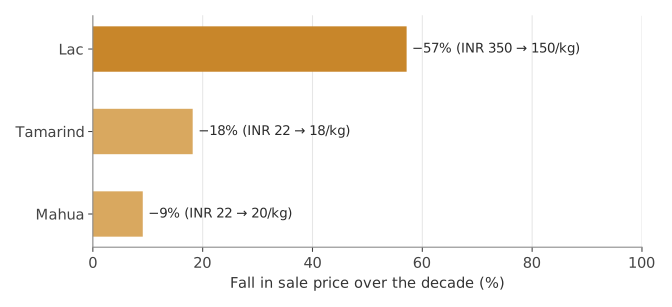
Climate change compounds each of the pressures above rather than acting as a separate hazard. In the Khunti collector population, declining lac yield attributable to rising maximum temperature (Section 1.6) fed directly into price volatility. Over the decade preceding the study, sale prices fell as follows (Figure 5.2) (Magry et al., 2023):
- lac from roughly INR 350 to 150/kg;
- mahua from INR 22 to 20/kg; and
- tamarind from INR 22 to 18/kg.
Collectors attributed the decline partly to falling volumes and partly to the degraded quality of climate-stressed produce.
Respondents also linked the crisis to institutional failure consistent with Section 5.3.2. 22% cited the exclusion of their own indigenous climate knowledge from institutional adaptation planning as a specific barrier. The adaptation strategies collectors had actually adopted (water harvesting, crop rotation, alternative livestock income) were overwhelmingly oriented toward agriculture rather than NTFP collection. That left the forest-produce side of household income with essentially no dedicated coping mechanism (Magry et al., 2023).
Crisis-management insight
Climate change functions here as a threat multiplier rather than a standalone hazard. It depresses yield (production, Section 1.6), erodes price (marketing, Section 5.3.3), and exposes the same institutional gap identified in Section 5.3.2, where a policy safety net exists on paper but does not reach the population it was designed to protect.
5.3.5 Regulatory response as crisis mitigation: the 2020 MSP expansion
The COVID-19 pandemic offers a documented case of forest-sector crisis response at national policy level. In direct response to pandemic-driven loss of income among tribal minor-forest-produce gatherers, the Ministry of Tribal Affairs expanded minimum support price coverage from 50 to 73 items in May 2020. It subsequently expanded coverage to 87 items by November 2020, alongside price revisions of up to 90% for some items (Press Information Bureau, 2020).
This was an explicit acknowledgement that forest-produce income functioned as a critical safety net for tribal households when other livelihood options collapsed during lockdowns. It shows a government using an existing marketing mechanism (Section 4.4.4) as a rapid-deployment crisis-response tool, rather than building a new relief programme from scratch.
5.3.6 Building resilience: lessons from the case studies
- Diversify income sources within the enterprise. Combining NTFP-based enterprise income with livestock and savings-and-loan services, as community-based forest enterprises in Nepal did, reduces dependence on any single, climate-exposed produce (Pandit et al., 2009).
- Build staged, not all-at-once, capital commitments (Section 3.3.3), so that a single bad season does not threaten the enterprise’s survival.
- Invest in governance transparency. Cooperatives prone to elite capture were flagged as a specific vulnerability in the Nepal study. Elite capture weakens trust and member participation precisely when unified action is most needed (Pandit et al., 2009).
- Treat awareness-building as crisis-prevention infrastructure. The Khunti finding that collectors were largely unaware of the MSP mechanism meant that a real safety net existed but could not be activated by the people it was designed to protect (Magry et al., 2022).
- Extend NTFP-specific adaptation, not just agricultural adaptation, into the coping-strategy mix. Existing coping practices (water harvesting, crop rotation, livestock) leave forest-produce income essentially unprotected against slow-onset climate crisis (Magry et al., 2023).
Discussion questions
- Choose one crisis category from this section (policy/tenure risk, institutional fragility or price volatility) and explain how climate change specifically amplifies it in the Khunti case.
- Compare the 2020 MSP expansion with the concept of ‘big bet versus real options’ investment decisions (Section 3.3.3). Which logic best describes the government’s crisis response, and why?
- Design one low-cost intervention that would close the awareness gap documented in Section 4.4.5 and thereby reduce the ‘paper safety net’ problem described in Section 5.3.2.
5.4 Crisis management in timber-based enterprises
5.4.1 Distinct crisis categories for timber enterprises
Timber-based enterprises face a different profile of crisis risk, shaped by their larger capital base, more formal contracts, and greater exposure to biophysical hazards affecting standing stock:
- Biophysical/operational crises. Wildfire and pest or disease outbreaks can destroy standing timber with little warning, wiping out years of growth in a single season.
- Regulatory and trade shocks. A sudden export ban, tariff change, or new certification or legality-verification requirement can abruptly close off a previously reliable market.
- Enforcement crackdowns. A sudden regulatory crackdown on illegal or under-documented logging can disrupt supply chains that had relied on informal sourcing, even for enterprises not directly targeted.
- Occupational safety incidents. Given the physically hazardous nature of harvesting and silviculture work (Section 2.3), a serious workplace accident functions as an acute operational crisis with legal, reputational and financial dimensions all at once.
- Commodity price cycles. Timber prices are often linked to broader construction and housing-market cycles, exposing enterprises to sudden demand collapse unrelated to their own management.
5.4.2 Crisis management approach in timber enterprises
Timber enterprises, especially company-managed ones, tend to have more formal governance and better access to financial instruments (Chapter 3). Their crisis management therefore leans more on formal risk-transfer tools:
- insurance against fire and pest loss;
- diversified buyer contracts to avoid dependence on a single market; and
- financial reserves built from more predictable, contract-based revenue.
This contrasts with the informal, community-level coping mechanisms (savings-and-loan schemes, government minimum support pricing) that dominate NTFP-sector crisis response (Section 5.3).
Discussion questions
- Why might a company-managed timber enterprise be able to use insurance as a crisis-management tool in a way that a community-managed NTFP enterprise generally cannot?
5.5 Comparative synthesis
The crisis profiles of the two enterprise types are compared in Table 5.1.
| Dimension | Timber-based | Non-timber-based (NTFP) |
|---|---|---|
| Typical crisis type | Often sudden (fire, trade ban, accident) | Often slow-onset (policy, institutional, price, climate) |
| Main source of vulnerability | Biophysical hazard and market-cycle dependence | Weak bargaining power, policy exclusion, thin institutions |
| Primary coping tools | Insurance, diversified contracts, financial reserves | Savings-and-loan schemes, government minimum support pricing, income diversification |
| Governance–crisis link | More formal governance generally supports faster formal response | Governance fragility (e.g., elite capture) itself often part of the crisis |
Overall discussion question
- Climate change is described in this chapter as a ‘threat multiplier’ for NTFP enterprises. Using the crisis categories in Section 5.4.1, explain whether climate change would be likely to act as a threat multiplier for timber-based enterprises in the same way, or differently.
5.6 Chapter Summary
Fill in the blanks
Answers are given at the end of the chapter.
- The four stages of crisis management are prevention, preparedness, response and __________.
- A crisis in which several pressures build up gradually is called a __________-onset crisis.
- In Nepal, District Development Committees could tax NTFP royalties at __________%.
- A safety net that exists on paper but does not reach the people it protects is called a __________ safety net.
- In Khunti, the sale price of lac fell from about INR 350 to INR __________/kg.
- Climate change acts as a threat __________ across other crisis categories.
- In 2020, MSP coverage expanded from 50 to 73 and then to __________ items.
- Cooperatives prone to elite __________ were flagged as vulnerable in the Nepal study.
- A key formal risk-transfer tool for timber enterprises is __________ against fire and pest loss.
Short-answer questions
- Explain the four stages of crisis management.
- Distinguish between sudden and slow-onset crises, with forest-sector examples.
- Describe the policy and tenure risks faced by community forest enterprises in Nepal.
- How does climate change act as a threat multiplier for NTFP enterprises in Khunti?
- Why is the 2020 MSP expansion described as crisis mitigation?
- List the lessons for building resilience in NTFP enterprises.
- Compare the crisis profiles of timber-based and NTFP enterprises.
Quick revision
- Crisis management → prepare, respond, recover; four stages: prevention, preparedness, response, recovery.
- Forest crises → mostly slow-onset; need monitoring and staged mitigation.
- Four categories → policy/tenure, institutional fragility, price volatility, climate change (threat multiplier).
- Nepal policy risks → product bans, export documents only for companies, EIA costs, 10% royalty tax.
- Paper safety net → institutions exist but do not reach collectors.
- Khunti prices → lac INR 350 → 150, mahua 22 → 20, tamarind 22 → 18 per kg.
- 2020 MSP expansion → 50 → 73 → 87 items; existing mechanism used for crisis response.
- Resilience → diversify, stage capital, transparent governance, awareness, NTFP-specific adaptation.
- Timber crises → fire, pests, trade shocks, crackdowns, accidents, price cycles; tools are insurance, diversified contracts, reserves.
Answers to fill in the blanks
1. recovery 2. slow 3. 10 4. paper 5. 150 6. multiplier 7. 87 8. capture 9. insurance