3 Financial Management in Forest-Based Enterprises
Financial management in forest enterprises is dominated by two recurring problems: assessing whether a venture is viable before committing scarce capital, and financing operations under conditions of high uncertainty (seasonal supply, fluctuating prices and limited access to formal credit). This chapter introduces the basic concepts and then examines how these problems are handled in community-managed and company-managed enterprises, and in timber-based and non-timber-based enterprises.
3.1 Foundational concepts
3.1.1 What is financial management?
Financial management is the function concerned with planning, organising, directing and controlling the financial activities of an enterprise, principally how it raises funds (procurement) and how it uses those funds (utilisation), so as to achieve the organisation’s objectives efficiently.
3.1.2 Basic functions of financial management
Financial management in any enterprise, including a forest-based one, revolves around five core decision areas:
- Investment decision (capital budgeting): deciding where and how much to invest, e.g., in equipment (a mobile saw), plantation establishment or processing infrastructure, and evaluating whether a venture is viable before scarce capital is committed.
- Financing decision: deciding where funds will come from (owners’ equity/share capital, member savings, borrowed funds, or donor/grant support) and in what mix.
- Dividend / surplus-utilisation decision: deciding how much of any surplus or profit is distributed to owners or members and how much is retained and reinvested in the enterprise.
- Working capital / liquidity decision: managing day-to-day cash flow (funding raw material purchase, wages and short-term operating costs), which is especially critical where revenue is seasonal.
- Financial planning and control: budgeting, forecasting, and monitoring actual performance against plans, using financial ratios and statements to guide decisions.
3.1.3 Key financial performance measures
Three measures recur across forest-enterprise financial assessment (Piabuo et al., 2025) and are worth defining clearly at the outset:
- Operating efficiency ratio compares operating expenses (goods sold, workforce, overhead) with revenue. A lower ratio indicates a more financially healthy business with better returns on investment; a ratio of around 50% or less is generally considered excellent.
- Operating profit is the income earned from an enterprise’s core operations before taxes, interest and other non-operating expenses. It shows the underlying profitability of the business itself, independent of financing or tax structure, and helps guide decisions on pricing, cost control and resource allocation.
- Net profit is the amount remaining after deducting all expenses (operating and non-operating) from total revenue for a period. It is the key figure used by owners, investors and lenders to judge overall profitability, plan growth and assess loan repayment capacity.
\[ \text{Operating efficiency ratio} = \frac{\text{Operating expenses}}{\text{Revenue}} \times 100 \]
This example is illustrative and is not taken from the case studies. A women’s honey-processing group earns INR 4,00,000 in a year. Its operating expenses (raw honey bought from members, wages, jars, rent) come to INR 1,80,000. Interest on a bank loan is INR 20,000.
- Operating efficiency ratio = 1,80,000 ÷ 4,00,000 × 100 = 45%, which is below the 50% benchmark.
- Operating profit = 4,00,000 − 1,80,000 = INR 2,20,000.
- Net profit (before tax) = 2,20,000 − 20,000 = INR 2,00,000.
3.1.4 Two recurring problems in forest-enterprise financial management
Across both community-managed and company-managed forest enterprises, financial management is dominated by two recurring problems:
- Assessing viability before committing capital: deciding, in advance, whether a venture (a new product line, a piece of equipment, an expansion) is worth the scarce capital it requires.
- Financing operations under high uncertainty: seasonal raw-material supply, fluctuating prices and, for many community enterprises, limited access to formal credit.
Keep these two problems in mind through the rest of the chapter. Every financing choice described below (cost-sharing, staged investment, subsidised savings-and-loan schemes, share capital) is essentially a different way of managing one or both of them.
Discussion questions
- Which of the five basic financial management functions (Section 3.1.2) would you expect to be hardest for a forest enterprise with highly seasonal income, and why?
- Using the definitions in Section 3.1.3, explain why a forest enterprise could have a healthy operating profit but still fail on liquidity.
3.2 Two cross-cutting dimensions of forest enterprises
Forest-based enterprises differ along two independent dimensions that both affect financial management:
- who owns and governs the enterprise (community-managed or company-managed); and
- what it produces (timber-based or non-timber forest product-based).
The two dimensions cut across each other: a community can run a timber enterprise, and a company can be built around a non-timber product. It is therefore worth seeing all four combinations (Table 3.1) before looking at each dimension separately.
| Governance | Timber-based | Non-timber-based (NTFP) |
|---|---|---|
| Community-managed | e.g., community forestry groups that selectively log and sell timber under contract, often sharing expensive equipment (such as a mobile saw) across neighbouring groups to reduce fixed costs | e.g., Forest User Groups or cooperatives processing and selling forest products such as nuts, fibre or fruit, financed mainly through member savings and subsidised community credit |
| Company-managed | e.g., private harvesting/silviculture contracting firms operating under commercial contracts, able to draw on standard commercial credit and formal accounting | e.g., the company form of a community-based enterprise once it formalises, or an agribusiness built around an NTFP, able to attract external investors and traders as shareholders |
3.3 Financial management in community-managed forest enterprises
3.3.1 Nature of capital and ownership
In a community-managed forest enterprise (a Forest User Group, network or cooperative), the members are simultaneously the owners, the workforce and (often) the customers or beneficiaries. There is no separate class of outside shareholders to raise capital from; funds must be mobilised from within the membership or from supporting institutions (government, donors, NGOs).
3.3.2 Sources of finance
The Nepal community-based forest enterprise study provides financial detail at the organisational level (Pandit et al., 2009):
- Member savings and compulsory savings-and-loan schemes. Nearly universal across FUGs and cooperatives, these convert small, regular member contributions into a pool of investable capital and, over time, into share capital for members who could not otherwise afford to buy in.
- External revolving funds. Many savings-and-loan schemes are topped up by donor-programme revolving funds rather than relying on member savings interest alone.
- Subsidised, pro-poor lending rates. Interest rates charged to the poorest members were frequently held below 12% per annum, roughly half of what standard microfinance institutions charged at the time. This was a deliberate equity-focused financial policy rather than a purely commercial one.
3.3.3 Financing risk approach: staged investment over big-bet investment
Revenue in community enterprises is often tied to unpredictable annual productivity (a tree’s yield varies year to year), and formal credit instruments are largely unavailable. Community enterprises therefore typically cannot safely commit large fixed capital upfront. They instead favour a staged, risk-distributed, real-options style of investment rather than one large upfront investment (Makkarennu et al., 2021). Examples include maintaining existing customer relationships while slowly building new market access, or building government and NGO partnerships to access capital and technology incrementally.
3.3.4 Case study: the Business Model Canvas applied to a candlenut enterprise
A study of the candlenut (kemiri) NTFP business in Maros Regency, South Sulawesi, Indonesia, assessed the financial viability of small-scale candlenut businesses (Makkarennu et al., 2021). It applied the Business Model Canvas (BMC), covering customer segments, value proposition, channels, customer relationships, revenue streams, key resources, key activities, key partnerships and cost structure. It combined the BMC with SWOT and Internal/External Factor Evaluation (IFE/EFE) matrices.
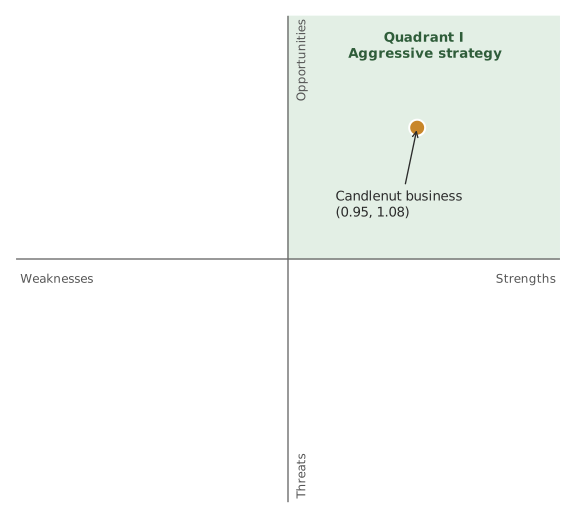
Factors in the IFE and EFE were weighted 0.0–1.0 and rated 1–4 by respondent condition. The study found internal strength scores of 2.49 against internal weakness scores of 1.54, and external opportunity scores of 3.00 against threat scores of 1.92. Plotted on a SWOT positioning quadrant, this placed the candlenut business in Quadrant I, a strong internal position combined with strong external opportunity (Figure 3.1). This indicated that an aggressive growth strategy was financially justified (Makkarennu et al., 2021).
Critically, the same analysis identified the value proposition itself as the single largest barrier to business improvement, scoring lowest among all internal strength factors. The revenue-generation mechanism was simple fixed-menu pricing based on quantity and quality, with prices that had remained largely static for years. The cost structure was kept deliberately low because production relied entirely on manual, non-electrified labour (Table 3.2).
| BMC element | Finding for the candlenut enterprise |
|---|---|
| Revenue streams | Fixed pricing by quantity/quality; about IDR 12,000 per litre for whole candlenuts; largely unchanged for years |
| Cost structure | Low, cost-driven; manual labour, no electricity dependency |
| Key resources | Human labour and tree access; minimal capital equipment |
| Weakest link (IFE) | Value proposition (lowest internal strength score, 0.15 weighted) |
| Strategic position (SWOT quadrant) | Quadrant I: strong position, real opportunity; supports an aggressive/progressive strategy |
The strategic responses recommended by the SWOT–BMC analysis are all staged, risk-distributed financial moves rather than single large investments (Makkarennu et al., 2021):
- maintaining customer relationships (S–T strategy);
- leveraging information technology for direct market access (W–O strategy); and
- building government and NGO partnerships for capital and technology access (W–T strategy).
3.3.5 Perceived Entrepreneurial Feasibility (PEF) as an individual financial decision filter
At the level of the individual member-entrepreneur within a community enterprise, a useful concept is Perceived Entrepreneurial Feasibility (PEF). It is a person’s specific, situational judgement of whether they personally have the skill and resource base to carry out a particular venture, as distinct from general confidence in themselves (Banerjee et al., 2025).
PEF is typically built incrementally rather than assessed once. Respondents in the Jharkhand rural entrepreneurship study described it being built in three ways (Banerjee et al., 2025):
- through formal training, for instance NGO-led goat-farming training after an initial livestock loss;
- through scaling up gradually once an initial small-scale attempt proved workable, for example starting with ten goats and scaling to 180 after retraining; and
- through government-backed infrastructure that removed a specific capital constraint, such as MGNREGA-funded farm wells removing a water-access barrier to farming.
For community and forest-adjacent entrepreneurs, this means financial feasibility is built step by step through supported de-risking, rather than settled by a single upfront calculation.
3.3.6 Broader performance evaluation: beyond pure profit
Community enterprises are accountable to their membership (and often to donors) for more than just financial return. Their performance evaluation therefore typically extends beyond profit and loss to include (Piabuo et al., 2025):
- Social performance: the number of community members employed (full-time and part-time) and the monetary value of that employment, the share of jobs held by women, and any direct investment in social projects.
- Environmental performance: indicators such as the incidence of illegal logging and the area of forest land cleared for other economic uses, tracked over time from a baseline year.
3.3.7 Diversification as a risk-management strategy
Community forest enterprises (CFEs) often diversify across several different products rather than relying on a single one, precisely because each product carries a different financing and revenue-risk profile. A study of CFEs in Cameroon illustrates four broad types (Piabuo et al., 2025):
- Timber-based CFEs selectively log and sell under contract to buyers who specify species, price and quantity in advance. Expensive equipment such as a mobile saw is jointly owned and cost-shared across neighbouring groups to reduce fixed costs.
- NTFP-based CFEs purchase raw produce (such as nuts) from community members, process it and sell it into wider markets.
- Agroforestry-based enterprises cultivate and sell a food crop on available fertile land, motivated by known market outlets.
- Aquaculture-based enterprises valorise a water resource within the forest (such as a fishpond) when timber or NTFP resources are limited, motivated by market access and resource protection.
Discussion questions
- Choose two of the four CFE types in Section 3.3.7 and compare their likely financing needs and revenue predictability.
- Using the IFE/EFE method from the candlenut study (Section 3.3.4), sketch how you would score a small-scale cardamom-grower enterprise’s internal strengths and external opportunities.
- Why might a real-options financing approach suit forest-based enterprises better than a big-bet approach, given the seasonal and ecological uncertainty in raw material supply?
3.4 Financial management in company-managed forest enterprises
3.4.1 Nature of capital and ownership
In a company-managed forest enterprise, ownership (shareholding) is separate from the day-to-day workforce, and governance is proportional to shareholding rather than one-member-one-vote. This separation is precisely what allows a company to raise capital from people who are not themselves forest users or workers.
3.4.2 Sources of finance
- Share capital from external investors. Of the different community-based organisational forms, companies mobilise the largest volume of share capital, ahead of cooperatives, precisely because they can attract traders and businesspeople as shareholders rather than relying only on member savings (Pandit et al., 2009).
- Commercial contracts as a revenue base. Company-style enterprises can negotiate supply contracts in advance (price, quantity and specification agreed before production or harvest), giving a more predictable revenue base to plan financing against.
- Greater access to formal credit. Formal accounting practices and a clearer ownership and collateral structure generally give company-form enterprises easier access to bank and institutional credit than informal community groups have.
3.4.3 Financial control and performance measurement
Because company-managed enterprises keep more formal accounts, the standard financial ratios introduced in Section 3.1.3 (operating efficiency ratio, operating profit and net profit) are the natural tools for evaluating their performance, in much the same way as for any conventional commercial firm. Financial control also tends to be more centralised, following a normal budgeting-and-reporting cycle rather than a member-meeting-based decision process.
3.4.4 The governance–finance trade-off
The same feature that gives companies better access to capital, proportional-to-shareholding governance, also has a cost. As an enterprise formalises from a community group into a company, control (and therefore the direction of financial decisions) shifts toward whoever holds the most shares. This is usually the better-off members, traders or outside investors rather than the poorest original members (Pandit et al., 2009).
3.5 Financial management in timber-based and non-timber-based forest enterprises
3.5.1 Revenue certainty and pricing
Timber-based enterprises typically negotiate price, species and quantity with a buyer in advance of logging, giving relatively predictable, contract-based revenue (Piabuo et al., 2025). Non-timber forest product (NTFP) enterprises, by contrast, often sell at a largely fixed menu price based on quantity and quality that can remain static for years (Makkarennu et al., 2021). Revenue growth in NTFP enterprises therefore depends on volume or diversification rather than on price movement, and is more exposed to swings in annual biological productivity.
3.5.2 Capital intensity and cost structure
Timber enterprises generally require more capital equipment (such as a mobile saw). It is expensive enough that neighbouring enterprises may jointly own and cost-share it purely to reduce fixed costs and improve profitability. NTFP enterprises tend to run a low, cost-driven structure built around manual, non-electrified labour, with minimal capital equipment. This keeps fixed costs low but also caps how much efficiency gain is available from cost control alone.
3.5.3 Financing approach under uncertainty
Timber enterprises manage financing risk mainly through cost-sharing and joint asset ownership, spreading the fixed cost of expensive equipment across several enterprises. NTFP enterprises manage the same underlying risk (uncertain, seasonal revenue and limited formal credit) mainly through staged, incremental investment. They prove a small-scale concept before scaling it up, and build government or NGO partnerships gradually rather than seeking one large upfront investment.
3.5.4 Summary
The financial contrasts between the two enterprise types are summarised in Table 3.3.
| Dimension | Timber-based | Non-timber-based (NTFP) |
|---|---|---|
| Revenue basis | Negotiated contract: price, species and quantity agreed in advance | Largely fixed menu pricing by quantity/quality, often static for years |
| Capital intensity | Higher: specialised equipment (e.g., mobile saw) | Lower: manual, non-electrified, labour-driven |
| Main financing-risk tool | Cost-sharing / joint ownership of equipment across enterprises | Staged, incremental investment (real-options approach) |
| Main source of revenue uncertainty | Market/buyer-side price negotiation | Annual biological productivity and price stagnation |
Discussion questions
- If an NTFP enterprise’s price has been static for years, what financial (not just marketing) options does it have to grow revenue?
3.6 Chapter Summary
Fill in the blanks
Answers are given at the end of the chapter.
- The investment decision in financial management is also called capital __________.
- An operating efficiency ratio of around __________% or less is generally considered excellent.
- Income from core operations before taxes, interest and non-operating expenses is called __________ profit.
- Community enterprises usually prefer staged, real-__________ style investment over a single big bet.
- In the candlenut study, the business was placed in Quadrant __________ of the SWOT positioning matrix.
- The weakest internal factor of the candlenut enterprise was its value __________.
- In the Nepal study, lending rates for the poorest members were often held below __________% per annum.
- Timber CFEs in Cameroon jointly own and cost-share an expensive mobile __________.
- In a company, governance is proportional to __________ rather than one-member-one-vote.
Short-answer questions
- Explain the five basic functions of financial management with forest-enterprise examples.
- Define operating efficiency ratio, operating profit and net profit.
- What are the main sources of finance for community-managed forest enterprises?
- Describe how the Business Model Canvas, SWOT and IFE/EFE matrices were used to assess candlenut enterprises.
- What is Perceived Entrepreneurial Feasibility, and how is it built?
- Explain the governance–finance trade-off as a community enterprise becomes a company.
- Compare the financial management of timber-based and NTFP-based enterprises.
Quick revision
- Financial management → raising funds (procurement) and using them (utilisation).
- Five decisions → investment, financing, dividend/surplus, working capital, planning and control.
- Measures → operating efficiency ratio (≤50% excellent), operating profit, net profit.
- Two problems → viability before committing capital; financing under uncertainty.
- Community finance → member savings, revolving funds, subsidised pro-poor lending (<12%).
- Staged (real-options) investment beats big bets where yields are uncertain.
- Candlenut → Quadrant I (aggressive strategy); value proposition is the weakest link.
- PEF → built step by step through training, gradual scaling and supportive infrastructure.
- Company finance → external share capital, contracts, formal credit; control shifts to large shareholders.
- Timber → contracts and cost-sharing; NTFP → fixed prices and staged investment.
Answers to fill in the blanks
1. budgeting 2. 50 3. operating 4. options 5. I 6. proposition 7. 12 8. saw 9. shareholding