flowchart LR
  S["<b>Strategic</b><br/>about one rotation<br/>(e.g., 40 years)<br/><i>wood flows, silviculture,<br/>harvesting strategy</i>"]
  T["<b>Tactical</b><br/>mid-term<br/>(e.g., 5 years)<br/><i>transportation,<br/>mill processing</i>"]
  O["<b>Operational</b><br/>one day to one year<br/><i>daily operations</i>"]
  S --> T --> O
6 Forest Supply Chain Management
This chapter examines the wood supply chain, the multiple interlinked value chains of the forest-based sector, the levels at which forest supply chains are planned, and the case for integrating those planning levels. It then places non-timber forest products and timber sourcing within this supply-chain perspective, drawing on the cases already introduced in Chapter 1.
6.1 The wood supply chain
The wood sector is a major contributor to many economies around the world. The high levels of employment and income generated by this sector can be associated not only with the different finished products that can be obtained from forests (i.e., lumber, wood products, paper and pulp products, biofuels), but also with the numerous and heterogeneous activities and processes carried out across the industry (Molinaro & Orzes, 2022). An overview of these activities, from forest to finished product, is shown in Figure 6.1. Five main processes can be distinguished: forest management; harvesting; storage and transportation; processing and manufacturing; and sales, distribution and maintenance.
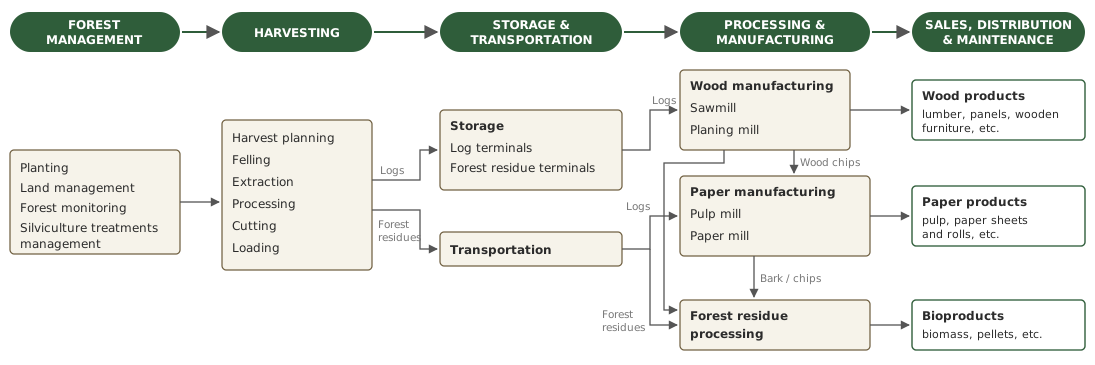
- Forest management deals with all the activities aimed at guaranteeing the health of forests and the availability of trees for their possible different uses (D’Amours et al., 2008). Sub-activities include planting, land management, forest monitoring and the management of silvicultural treatments.
- Harvesting consists of all the cutting and extraction activities (X. Zhang et al., 2020), including decisions on felling sites, trees to be cut and roadside transportation lines (Scholz et al., 2018). It comprises harvest planning, felling, extraction, processing, cutting and loading. Forest residues, alternatively called forest biomass, are collected during this process.
- Storage and transportation is the third process of the wood supply chain. It refers to the movement of logs and biomass from the forest to industrial plants or to intermediate distribution centres (log terminals and forest-residue terminals) for temporary storage (D’Amours et al., 2008).
- Processing and manufacturing can follow transportation in three ways, depending on the desired final product (D’Amours et al., 2008):
- logs can be processed in sawmills and planing mills into wood components (lumber, boards, panels) and finished wood products (furniture, flooring, roofing systems);
- they can be used for paper sheets, rolls and packaging through pulp and paper mills; or
- bioproducts (biomass, pellets, etc.) can be created by processing forest residues, bark and chips discarded by wood and paper manufacturing.
- Sales, distribution and maintenance, the final process, concerns not only sale but also the maintenance activities of the final products across their whole life cycle.
6.2 Forest supply chain management: multiple, interlinked value chains
In the current business environment, effective coordination among entities within supply chains is paramount for company success. Traditionally, activities such as raw material acquisition, production, storage, transportation and product distribution were treated separately. The key components of the forest supply chain are forest management, harvesting and extraction, transportation, industrial processing and distribution. Combining forestry strategic decisions with those related to production, distribution and sale is crucial (Rodriguez et al., 2025).
6.2.1 Five parallel value chains within the forest-based network
Within the forest-based value-creation network, several value chains can be distinguished, each with activities that depend on the industrial sector being analysed. All of these value chains are interlinked and in constant adaptation (D’Amours et al., 2016). They behave as complex networks that connect forests with markets, and require efficient coordination of decisions at the strategic, tactical and operational levels. The five chains are:
- sawn wood, panels and engineered wood products (EWP);
- biorefinery;
- bioenergy;
- paper production; and
- manufacture of finished products sold in different markets.
6.2.2 The wood value chain and the constraint of tree growth
The wood value chain is one of the most important within the forestry sector, and wood products are used in numerous applications. The distinction between the wood value chain and forestry more broadly arises mainly because the raw material for the wood industry is obtained from cultivated forests (Ramage et al., 2017), while its residue, forest biomass, is used for energy generation.
A major factor affecting planning in the forestry industry is the growth cycle of trees. Growth is a slow process, so optimal use of the trees is required. The transformation of trees into products involves a large number of activities. The types of products obtained vary according to the characteristics of the country, the ownership structure of forest lands, the level of vertical and horizontal commercial integration of the activity, and the predominant business models, among other things. These are value-creation actions of an economic, environmental and social nature (Rodriguez et al., 2025).
6.2.3 Bioenergy generation from forest biomass and waste
Due to the large amount of waste generated by the forest industry, energy generation within the supply chain is considered a viable alternative. The use of biomass for energy production is feasible not only because of the significant amount generated by different activities (mainly in the forest industry) but also because of its environmental benefits as a renewable resource (Barberio et al., 2023).
However, its economic feasibility is influenced by a wide range of factors (Shabani & Sowlati, 2013). These include long-term availability, acquisition costs, quality, and the expenses of collection, preprocessing, handling, transportation and storage of biomass. The viability of bioenergy generation also depends on the costs of installing, operating and maintaining power generation plants. Given all of these factors and their interconnectedness with other forestry activities, there is a clear need for efficient and comprehensive forestry supply chain management (Rodriguez et al., 2025).
6.2.4 Why forest products matter
Forest products remain an essential part of modern society. They meet the demand for wood fibre, contribute to long-term carbon-emissions abatement, undergo a significant recycling phase that extends carbon storage, and replace fossil fuels (Timber NSW, 2020). In construction, forest products are the only significant construction material that can be grown (Ramage et al., 2017), offering advantages over other materials in being sustainable and renewable. Demand for forest products is expected to remain strong, placing native forest resources at continued risk of overexploitation. To meet demand sustainably, forest companies managing commercial plantations need to play a larger role in supplying timber resources over the long term (Australian Government, 2019).
Forest companies are upstream business entities that must plan the forest to replant, cultivate and harvest based on downstream entities’ demand. But the forest supply chain is often an intricate network, because of many-to-many relationships, diverse planted species, complex growing conditions, various products in forests and sawmills, and varied ownership of forests and their downstream wood-processing plants (Luo et al., 2021).
Forest supply chain management has been shown to effectively improve forest-products firms’ economic performance (X. Zhang et al., 2020). Participants work across organisational boundaries to deliver log and timber products throughout the supply chain (Bettinger et al., 2017), operating over large spatial scales and long temporal horizons. This makes integrated supply chain management critical for industry success and profitability.
6.2.5 Three levels of supply chain planning
Commonly, forest supply chain planning operates at three levels (Figure 6.2) (Asmussen et al., 2018; Bouchard et al., 2017; Government of South Australia, 2015):
- Strategic planning examines long-term wood flows over one rotation (e.g., 40 years) and large-scale decisions such as silviculture and harvesting strategy.
- Tactical planning deals with more detailed decisions regarding transportation and mill processing over the mid-term (e.g., five years).
- Operational planning is short-term (one day to one year), covering daily operations in the forest supply chain.
Forest management covering one or more forest rotations belongs to long-term strategic planning, while industry planners conduct tactical planning in the mid-term for wood-processing-plant operation (Troncoso et al., 2015). Ideally, supply chain network managers should coordinate activities to reduce organisational and information barriers. However, it is challenging to motivate supply chain managers from different firms to work together (Kong & Rönnqvist, 2014).
As a result, strategic forest planning and tactical wood-processing-plant planning are often managed in a decoupled manner, with planning frequently focusing on sub-problems in a hierarchical way. Examples include optimising log transportation (Bordón et al., 2018), production optimisation at sawmills (Broz et al., 2019), or harvest-stand connectivity and its implications for economic returns (Augustynczik et al., 2016).
6.2.6 The case for integrated planning
Integrated planning treats strategic (long-term), tactical (mid-term) and operational decisions as one connected problem rather than solving them separately (Luo et al., 2021). The evidence for its benefits, and an applied example, are summarised below.
Evidence from other industries
- Bioenergy supply chains: Akhtari et al. (2018) show that an integrated model can guarantee the feasibility of both strategic and tactical plans and avoid mismatches between planning levels.
- Bioethanol supply chains: J. Zhang et al. (2013) developed an integrated optimisation model to minimise cost and optimise the harvest method of a switchgrass-based bioethanol supply chain.
- Biomass feedstock logistics: Wang et al. (2020) conducted an optimisation study integrating harvest and logistics decisions for biomass feedstocks.
- Hydrogen supply chains: Li et al. (2020) applied an integrated optimisation model capturing technological and spatial interaction characteristics.
- Poultry industry: an integrated model found potential profit improvements of 7–57%, with inventory costs falling by 30–60% (Solano-Blanco et al., 2023).
Evidence from forestry supply chains
| Study | Method | Contribution |
|---|---|---|
| Barros & Weintraub (1982) | Linear programming (LP) | One of the earliest studies; vertically integrated the supply chain at both forest management and industry planning levels over a 50-year horizon, showing that mathematical modelling could support forest-estate expansion decisions |
| Troncoso et al. (2015) | Mixed integer linear programming (MILP) | Integrated 25 years of strategic planning with 5 years of tactical production planning in the Chilean forest industry; the net present value of forest and mill operations rose by up to about 5% compared with a decoupled, sequential method |
| Bouchard et al. (2017) | Dynamic programming with column-generation decomposition | Subproblems formulated as hypergraphs |
| Badri et al. (2013) | Heuristic solution method | Planned the integrated strategic and tactical supply chain |
| Fattahi et al. (2016) | Integrated strategic–tactical planning | Incorporated price-sensitive demand |
| Flynn et al. (2010) | Supply chain integration study | Incorporated supply-chain performance measurement |
Barriers to integration
- Relatively few studies actually integrate upstream forest management (strategic level) with downstream wood-processing plants (tactical level) (Kong & Rönnqvist, 2014).
- Different planning levels have distinct characteristics and time horizons, making a single unified model harder to build.
- Different divisions or firms carry different responsibilities, which weakens the incentive to coordinate.
- Existing decision-support systems are often not built to handle integrated, cross-level problems (Kong & Rönnqvist, 2014).
Applied example: industrial agroforestry in Tamil Nadu
A real-world illustration of integrated planning, outside the mathematical optimisation literature above, is Tamil Nadu Agricultural University’s industrial agroforestry programme (Parthiban et al., 2021), described in Section 1.4. Rather than treating genetic quality, propagation and waste management as separate problems, it addressed poor productivity, weak planting material and an unorganised supply chain as one connected system. The system spans the strategic, tactical and operational levels simultaneously (Table 6.2).
| Planning level | Intervention | Effect |
|---|---|---|
| Strategic | High Yielding Short Rotation (HYSR) clones | Improved genetic stock raised productivity from under 10 m³/ha/year to over 25 m³/ha/year and shortened felling rotations |
| Tactical | Miniclonal propagation technology | Mass multiplication with genetic uniformity replaced seed-based progenies that produced highly variable field growth |
| Operational | Value addition technology | The 5–10 tonnes of plantation residue generated per hectare are converted into fuel briquettes, turning a waste stream into a revenue stream |
| Outcome | All three adopted together | Benefit–cost ratios for plywood and pulpwood species rose from roughly 1.2:1 to 3.5:1 |
This integrated, coordinated approach can be usefully contrasted with an uncoordinated one: the informal, downstream-heavy NTFP value chain of Jharkhand (Section 1.1 to Section 1.3), where genetic quality, storage and waste handling are never brought together as a single connected system (Table 1.2).
6.3 Non-timber forest products (NTFPs) and their importance
Non-timber forest products (NTFPs) are biological materials other than industrial roundwood harvested from forests and trees outside forests. They include resins, gums, lac, fruits, seeds, flowers, leaves, fibres, and medicinal or aromatic plant parts. Unlike the timber value chains described in this chapter, NTFP collection typically requires low capital investment, uses traditional household skills, and can be undertaken alongside other livelihood activities. NTFPs are important for several interlinked reasons:
- they diversify and stabilise household income for forest-dependent and tribal communities, particularly where formal wage employment is scarce;
- they contribute directly to food and nutritional security;
- collection is generally non-destructive to the standing forest resource when practised sustainably, creating a direct economic incentive for local communities to conserve forest cover and biodiversity;
- NTFP collection is frequently a significant, though under-recognised, source of income for women, who dominate collection activities in many regions (Section 2.4.4); and
- in aggregate, NTFPs constitute a very large informal economy that rarely appears in official production statistics.
The production-to-consumption system for NTFPs, its yield variability, its materials-management failures and the growing climate risk to its resource base are examined through the Khunti (Jharkhand) case in Section 1.1 to Section 1.3 and Section 1.6. They are compared with the organised Tamil Nadu agroforestry model in Table 1.2.
6.4 Timber sourcing, regulation and state-controlled supply chains
From a supply-chain perspective, timber sourcing in India follows two broad models: state-managed natural or plantation forestry, as in Kerala, and farm or social forestry linked to captive raw-material pipelines, as in ITC PSPD’s contract-farming model (Section 1.7). Downstream, processing capacity is concentrated in a small number of large, often vertically integrated manufacturers (Section 1.9).
The whole chain operates under a dense, species- and zone-specific regulatory framework at national and state levels (Section 1.8). In Kerala, a large share of commercial timber moves through state-controlled depots, MSTC-run e-auctions and dedicated retail outlets rather than through private wholesalers (Section 1.10). Each of these arrangements represents a different answer to the supply-chain coordination problem discussed in Section 6.2.
6.5 Discussion questions
- Using the three levels of supply chain planning (Section 6.2.5), classify the decisions taken by a teak plantation manager in Kerala into strategic, tactical and operational decisions.
- Why are strategic forest planning and tactical wood-processing-plant planning often managed in a decoupled manner, and what does the evidence in Section 6.2.6 suggest is lost as a result?
6.6 Chapter Summary
Fill in the blanks
Answers are given at the end of the chapter.
- The wood supply chain has __________ main processes.
- Forest residues collected during harvesting are also called forest __________.
- Logs are converted into lumber, boards and panels in sawmills and __________ mills.
- Products made from residues, bark and chips, such as pellets, are called __________.
- Strategic forest planning typically covers about one __________ (e.g., 40 years).
- Tactical planning usually covers the mid-term, about __________ years.
- When strategic and tactical plans are solved separately, planning is said to be __________.
- In the Chilean case, integrated planning raised net present value by up to about __________%.
- NTFPs are biological materials other than industrial __________.
Short-answer questions
- Describe the five main processes of the wood supply chain.
- Name the five parallel value chains within the forest-based network.
- Why does the growth cycle of trees make forest supply chain planning difficult?
- What factors determine the economic feasibility of bioenergy from forest biomass?
- Explain the three levels of forest supply chain planning.
- What is integrated planning? Summarise the evidence for it and the barriers to it.
- Why are NTFPs important for forest-dependent communities?
Quick revision
- Wood supply chain → forest management → harvesting → storage and transportation → processing and manufacturing → sales, distribution and maintenance.
- Three processing routes → wood products, paper products, bioproducts.
- Five value chains → sawn wood/panels/EWP, biorefinery, bioenergy, paper, finished products.
- Planning levels → strategic (~1 rotation), tactical (~5 years), operational (1 day to 1 year).
- Decoupled planning loses value; integrated planning raised NPV by up to ~5% in Chile.
- Barriers → few studies, different horizons, divided responsibilities, unsuitable decision-support systems.
- TNAU model → strategic (HYSR clones), tactical (miniclonal propagation), operational (briquettes).
- NTFPs → low capital, household skills, income for women, conservation incentive, large informal economy.
Answers to fill in the blanks
1. five 2. biomass 3. planing 4. bioproducts 5. rotation 6. five 7. decoupled 8. 5 9. roundwood