4 Marketing Management of Forest Produce
Marketing management for forest-based enterprises spans negotiated timber contracts, informal weekly markets (haats), formal government procurement mechanisms and, increasingly, digital and e-commerce channels. This chapter introduces the basic concepts, contrasts timber and non-timber marketing, and examines in detail two topics: the Government of India’s Minimum Support Price (MSP) mechanism for Minor Forest Produce (MFP), and the online marketing models emerging in Kerala and elsewhere in India.
4.1 Foundational concepts
4.1.1 What is marketing management?
Marketing management is the process of planning and executing the conception, pricing, promotion and distribution of produce so as to create exchanges that satisfy both the enterprise’s objectives and the needs of its buyers. For a forest-based enterprise, this means everything between harvesting or collecting a product and its reaching a paying buyer.
4.1.2 Basic functions of marketing management
Marketing management in any enterprise, including a forest-based one, revolves around six core functions:
- Market research and analysis: understanding who the buyers are, what they need, what competitors offer, and how demand and prices move over time.
- Produce/product planning: decisions on grading, quality standards, processing level and packaging before produce is sold.
- Pricing: setting a price through negotiation, cost-based calculation, a fixed local menu rate, or a government-set floor price, depending on the market structure.
- Promotion and market access: building awareness among buyers and, increasingly, using direct or digital market linkages to reduce dependence on intermediaries.
- Distribution / channel management: choosing which intermediaries (local traders, cooperatives, registered exporters) the produce passes through on its way to the final buyer.
- Buyer relationship management: maintaining a stable, repeat relationship with known buyers, which matters especially where sales are business-to-business and contract-based.
4.1.3 Two recurring marketing problems in forest enterprises
Across timber and non-timber forest enterprises alike, marketing management keeps returning to two underlying problems:
- Information and power asymmetry along the value chain. Producers or collectors at the start of the chain typically know less about downstream prices and demand than the traders or buyers they sell to, which weakens their bargaining position.
- Price volatility or stagnation despite rising costs. Forest produce prices are often set by forces outside the individual enterprise’s control (climate-driven supply swings, distant buyers, or long-unrevised local rates). This erodes real income over time even without any single dramatic event.
Keep these two problems in view through the rest of the chapter. Almost every marketing intervention described below (certification, direct market access, minimum support pricing, online branding) is, at heart, an attempt to fix one of them.
Discussion questions
- Which of the six basic marketing functions (Section 4.1.2) would be hardest for an individual forest-produce collector, acting alone, to perform well?
- Give an example of how information asymmetry (Section 4.1.3) could persist even if a government sets a minimum price for a product.
4.2 Timber and non-timber marketing compared
Timber and non-timber forest products are typically sold through very different market structures, which shapes almost everything else about how they are marketed (Table 4.1).
| Feature | Timber-based products | Non-timber forest products (NTFPs) |
|---|---|---|
| Typical buyer | A small number of known buyers (mills, exporters) negotiating directly | A long, fragmented chain of local traders, aggregators and eventual processors/retailers |
| Price formation | Negotiated per contract (species, quantity, quality agreed in advance) | Often a fixed local rate, sometimes supplemented by a government minimum support price |
| Marketing emphasis | Contract negotiation, grading and reliable fulfilment | Market access, price awareness and reducing dependence on intermediaries |
| Typical vulnerability | Dependence on a small number of buyers and commodity-cycle demand | Weak bargaining power of collectors and low awareness of protective mechanisms |
4.3 Marketing management in timber-based enterprises
4.3.1 Nature of timber markets
Timber is typically sold business-to-business, through negotiated contracts rather than open retail sale. In the Cameroon community forestry case, for instance, enterprises negotiate directly with buyers who specify the timber species, price and quantity required. The enterprise then selectively logs and supplies against that agreed order (Piabuo et al., 2025). Marketing activity here is concentrated at the front end, securing and agreeing the contract, rather than at the point of sale.
4.3.2 Key marketing functions in timber enterprises
- Contract negotiation as the core marketing activity. Because species, price and quantity are agreed before logging begins, the negotiation itself substitutes for much of the promotion and retail selling a consumer product would need.
- Grading and specification compliance. Timber is generally sold to a specification, so consistently meeting agreed grade and quantity is itself a marketing asset that secures repeat contracts.
- Capacity to fulfil contracts reliably. Arrangements such as jointly owned equipment (e.g., a shared mobile saw) exist partly to make sure an enterprise can reliably deliver what it has contracted to supply, which is itself a form of market credibility.
- Limited need for consumer-facing promotion. Because the end buyer is typically a business (a mill, processor or exporter) rather than an individual consumer, conventional advertising plays a much smaller role than in most retail marketing.
4.3.3 Marketing strategies of large timber-based firms
Large timber and wood-product firms face a marketing problem almost opposite to that of the small, contract-based enterprises in Section 4.3.1 and Section 4.3.2. Rather than struggling for market access at all, their challenge is escaping commodity-style price competition. Structural/dimension lumber and plywood are typically sold against standardised industry grades that make conventional product differentiation difficult. The general marketing literature identifies several recurring strategic responses:
- Branding despite commodity status. Some producers pursue corporate or product-line branding specifically for newer product categories, such as reconstituted or engineered wood panels, where standardised grading is less entrenched. A brand name builds buyer preference where plain commodity grading would otherwise force pure price competition.
- Vertical integration into distribution. Rather than differentiating the physical product, some large firms integrate forward into wholesale distribution, competing instead on service quality, delivery reliability and consistency of supply.
- Diversification into higher-value, processed products. Moving from bulk or raw timber sales into processed, higher-value lines (for example, finished windows and doors rather than sawn timber) shifts a firm away from pure commodity competition. It opens more specialised B2B or even consumer-facing segments with room for branding and margin.
- Sustainability certification as a selling proposition. Certification schemes such as FSC or PEFC are increasingly used as a core marketing differentiator. They let a firm target environmentally conscious buyers and meet the sourcing commitments of its own downstream customers. Some firms set explicit, public certified-sourcing targets. For instance, one European sawn-timber and building-products firm has set a public target for the large majority of its wood raw material to be FSC- or PEFC-certified, turning a sourcing standard into a visible marketing commitment.
- B2B content and digital marketing. Buyers are mostly professionals (architects, contractors, builders, dealers) rather than end consumers. Large timber-product firms therefore rely heavily on technical content marketing (installation guides, product and application comparisons) optimised for the specific searches professional buyers make. They pair this with a social media presence oriented to professional networks; industry data suggest business-oriented platforms are used far more than consumer-style social media in this sector.
- Distributor and dealer channel support. Most large timber firms sell through independent distributors or dealer yards rather than directly to end users. Marketing strategy therefore also includes distributor-facing activity: co-branded promotional campaigns, dealer training, and co-operative (‘co-op’) advertising funds that let individual dealers run local promotions at shared cost.
4.3.4 Summary of large-firm timber marketing strategies
The strategies described in Section 4.3.3 are summarised in Table 4.2.
| Strategy | What it targets | Typical use case |
|---|---|---|
| Branding new product lines | Buyer preference despite commodity grading | Engineered/reconstituted wood panels |
| Vertical integration into distribution | Service and delivery reliability as differentiator | Firms competing on supply consistency rather than price |
| Diversification into processed goods | Escaping raw-commodity pricing entirely | Windows, doors and other finished wood products |
| Sustainability certification (FSC/PEFC) | Environmentally conscious and compliance-driven buyers | Public certified-sourcing targets as brand commitments |
| B2B content and digital marketing | Professional buyers researching specifications | Technical guides, comparisons, professional social media |
| Distributor/dealer channel support | Indirect sales through independent dealers | Co-branded campaigns, dealer training, co-op advertising funds |
Discussion questions
- Why might reliability of supply matter as much as price in a negotiated timber contract (Section 4.3.1 and Section 4.3.2)?
- What marketing risk does a small enterprise take on if it depends on a very small number of negotiated buyers?
- Why does branding matter more for newer, less-standardised timber products (like engineered panels) than for long-established commodity grades (like standard dimension lumber)?
- A large firm sets a public target for the share of its wood that must be FSC/PEFC-certified. Is this best understood as a sourcing policy, a marketing strategy, or both? Justify your answer.
- Compare the small-scale, contract-based marketing in Section 4.3.1 and Section 4.3.2 with the large-firm strategies in Section 4.3.3. What changes about marketing once a timber enterprise grows from a single-contract operation into a large firm selling through distributors?
4.4 Marketing management in non-timber forest product (NTFP) enterprises
4.4.1 Nature of NTFP markets and actor roles
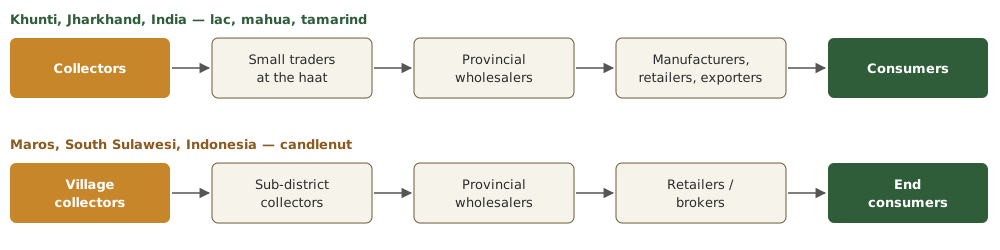
NTFP markets are typically fragmented and multi-tiered: produce passes from individual collectors, through local traders, and on to processors or retailers, often across several intermediary steps. The Khunti district study mapped the full market chain for lac, mahua and tamarind (Figure 4.1). Collectors sell to intermediaries or small traders at the local haat (weekly market); small traders sell to provincial wholesalers; wholesalers sell to manufacturers, retailers or exporters, who finally reach consumers (Magry et al., 2022).
A parallel chain for candlenut in Indonesia showed an almost identical structure: village collectors, sub-district collectors, provincial wholesalers, retailers/brokers, then end consumers (Makkarennu et al., 2021). This suggests that the multi-tier intermediary structure is a general feature of NTFP marketing, not an India-specific anomaly.
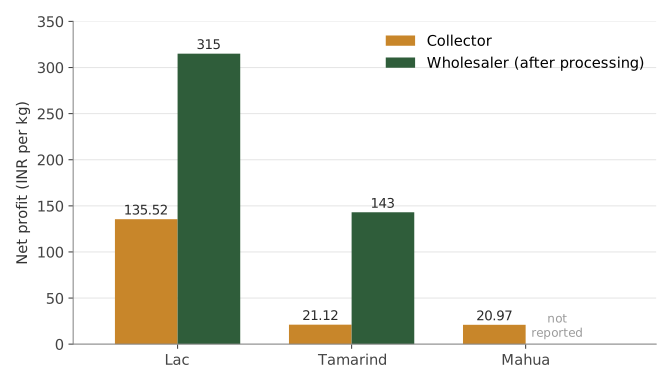
Gross margin analysis in the Khunti study quantified the resulting inequity precisely (Figure 4.2). NTFP collectors earned a net profit of INR 135.52/kg for lac, INR 20.97/kg for mahua and INR 21.12/kg for tamarind. Wholesalers earned INR 315/kg processing lac into button lac and INR 143/kg processing tamarind into powder (Magry et al., 2022). Collectors, despite supplying nearly all the physical labour and risk, captured the smallest share of final value at every stage of the chain.
Women dominate the upstream collection stage but are largely absent from downstream trading roles. Their market contact is limited to sale or occasional barter rather than any role in storage, pricing or market decisions (Section 2.4.4).
4.4.2 Constraints in market access
The principal constraints that keep collectors from capturing more value are the following:
- Limited direct access to end buyers. Collectors frequently have little or no direct access to end buyers, leaving most of the value to be captured by intermediary traders further down the chain.
- Poor market knowledge. Collectors, especially women, have minimal awareness of prevailing prices, alternative market locations or downstream buyers. Only 5.43% of female respondents in the Khunti study had market-price awareness, against 21.96% of male respondents (Magry et al., 2022).
- Distance and connectivity. Markets located far from villages limit collectors’ choice of buyer, reinforcing dependence on whichever trader visits the village.
- Barter and advance-loan dependency. Roughly 15% of surveyed collectors were still engaged in barter exchange for salt and daily commodities, and 8.5% had taken advance loans from traders. Both practices tie the collector’s future produce to a single buyer at a price the buyer controls (Magry et al., 2022).
- Weighing and measurement malpractice. Collectors reported being deceived through inaccurate manual weighing during sale. The study’s authors suggest this could be addressed through digital weighing machines at the village level.
- Low awareness of protective mechanisms. Even where a protective mechanism such as MSP exists, low awareness of it among the collectors it is meant to protect means the mechanism cannot actually be used. A real safety net then functions, in practice, as no safety net at all (Section 4.4.5).
4.4.3 Pricing mechanisms
- Static local pricing. In the candlenut case, prices for whole candlenuts were based on a simple, fixed rate by quantity and quality that had remained largely unchanged for years, even as costs elsewhere in the economy rose (Makkarennu et al., 2021).
- Minimum Support Price (MSP) as a floor-price mechanism. Governments can set a guaranteed minimum price for specified minor forest produce items. It is intended to protect collectors from being forced to accept whatever price local traders offer (Section 4.4.4).
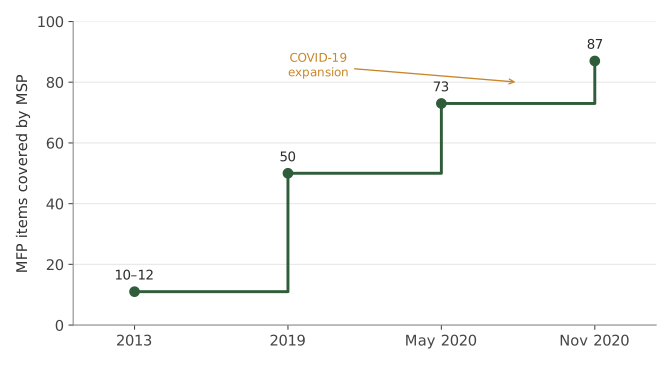
- MSP as a rapid crisis-response tool. During the COVID-19 pandemic, MSP coverage was expanded from 50 to 73 items and then to 87 items within the same year, with price revisions of up to 90% for some items (Press Information Bureau, 2020). This shows how an existing marketing mechanism can be redeployed quickly when incomes collapse.
4.4.4 Government mechanism: MSP for Minor Forest Produce
India’s central government addresses the collector-side price risk identified above through a dedicated Centrally Sponsored Scheme, the ‘Mechanism for Marketing of Minor Forest Produce (MFP) through Minimum Support Price (MSP) and Development of Value Chain for MFP’. It was introduced by the Ministry of Tribal Affairs in 2013 as a social safety net for MFP gatherers, who are overwhelmingly members of Scheduled Tribes (Ministry of Tribal Affairs, n.d.). Its key features are:
- Nodal agency. TRIFED (Tribal Cooperative Marketing Development Federation of India) is the apex national implementing body. Procurement on the ground is carried out by State-designated procuring or nodal agencies, with losses shared between the Centre and State in a 75:25 ratio.
- Coverage growth. The scheme began in 2011–2013 covering roughly 10–12 MFPs in a handful of states. By 2019 this had expanded to 50 items across all states. By 2020, in response to COVID-19 disruption to tribal incomes, coverage was expanded further to 87 items, with MSPs revised upward by as much as 90% for some produce (Press Information Bureau, 2020) (Figure 4.3).
- Objectives. The scheme aims to provide a fair, guaranteed floor price for produce collected. It aims to ensure the gatherer’s share of downstream sale revenue (net of documented costs) rather than a one-time raw-produce price. It also aims to bridge last-mile market access by activating haat bazaars as formal procurement points.
- Complementary component: Van Dhan Yojana. MSP is paired with the Van Dhan tribal start-up scheme, which organises gatherers into Van Dhan Vikas Kendras (VDVKs) for primary processing and value addition. The aim is to shift income capture upstream toward the collector rather than leaving it entirely with downstream traders. This directly addresses the value-addition gap documented in Section 1.1 and Section 4.4.1.
- Financing. The Ministry has released working-capital and revolving funds (over INR 319 crore reported as sanctioned to 18 State Procuring Agencies). The funds are meant specifically to let state agencies pay collectors promptly rather than delaying payment until produce is resold. This directly targets the distress-sale problem documented in the Khunti case study (Section 1.3).
4.4.5 Why the MSP mechanism has had limited effect in some regions
The MSP mechanism has been formally in place for lac, mahua and tamarind since 2011. Even so, the Khunti district study found that NTFP collectors continued to be underpaid relative to the MSP. Small traders and intermediaries were not obligated to procure at or above the MSP, and prices in practice continued to fluctuate at the trader’s discretion (Magry et al., 2022).
The study also found minimal awareness of the MSP mechanism itself among collectors. Only 3.10% of male and 2.58% of female respondents had any awareness of governance structures such as the MSP, welfare schemes or relevant regulations, with awareness concentrated among younger, literate respondents.
This gap between a well-designed national mechanism and its ground-level uptake is itself an important marketing-management lesson. A price-support policy only functions as intended where procurement agencies are actively present, and where gatherers are informed enough to invoke it.
4.4.6 Strategic marketing responses
The candlenut study points to four strategic responses for NTFP enterprises (Makkarennu et al., 2021):
- Redesigning the value proposition. The enterprise’s value proposition, not its cost structure or resources, was identified as the single largest barrier to improvement. This points marketing effort toward what is offered and how, rather than simply toward cutting costs.
- Building direct market access. Using IT and digital tools to reach buyers directly was identified as a way to bypass some of the intermediary layers that erode collector income.
- Product diversification. Moving beyond a single, static-priced product line was identified as an active strategic response to chronic price stagnation, rather than passively accepting it.
- Government/NGO partnership-building. Gradually building institutional partnerships was identified as a way to gain both market access and technology that an individual collector or small enterprise could not secure alone.
More recent literature points to e-commerce as a partial solution to the intermediary-margin problem. However, adoption remains constrained by low digital literacy among forest-dependent gatherers, inadequate rural logistics networks, the absence of standardised certification for forest products, and limited platform support for perishable produce. Digital channels therefore currently supplement, rather than replace, the traditional haat-to-wholesaler chain.
4.4.7 Case study: online marketing models for NTFPs in Kerala, Forest Post and Vanasree
Kerala offers two contrasting, real-world illustrations of the ‘direct market access’ and ‘partnership-building’ responses described in Section 4.4.6. Forest Post is a privately run social-enterprise brand; Vanasree is a Kerala Forest Department initiative. Both address the same core NTFP marketing problems (Section 4.1.3) but from very different institutional starting points.
Forest Post was established in 2017 by ecologist Dr Manju Vasudevan and her team as a project linked to the River Research Centre, with initial funding and product training from the Keystone Foundation. UNDP-India later provided business-process, marketing and branding support (30 Stades, 2024; Poyyail, 2021). The venture now trades through Dharaa Livelihood Initiative LLP under the Forest Post brand (Kerala Startup Mission, n.d.).
It works with indigenous gatherers, initially the Kadar, Malayar and Muthuvar communities, in the Chalakudy and Karuvannur river basins of central Kerala. It converts minor forest produce such as beeswax, wild honey, shatavari and forest fruit into branded skincare, wellness, food and bamboo-craft products (Poyyail, 2021; The Better India, 2022). Its online marketing model is direct-to-consumer (D2C) e-commerce built around:
- Storytelling-led branding. The tagline ‘Harvest Stories from the Wild’ and narrative content link each product back to its forest origin and the women who made it.
- Trust and impact signalling. Value badges (‘Rainforest Friendly’, ‘Community Sourced’, ‘Handmade’), quantified impact figures and customer testimonials.
- Third-party credibility marks. Logos of partners such as the Keystone Foundation, UNDP and the Kerala Startup Mission (KSUM), displayed as legitimacy signals.
- Multi-channel sales and social media. Sales run through its own website, curated marketplaces, mainstream e-commerce (Amazon) and select retail stores (30 Stades, 2024), with an active presence across Facebook, Instagram, X, YouTube and WhatsApp Business. A Kerala Startup Mission grant supported the venture (Kerala Startup Mission, n.d.), showing that this level of online marketing needed dedicated external funding rather than being self-financed from sales alone.
Vanasree, by contrast, is run directly by the Kerala Forest and Wildlife Department under the State Forest Development Agency. It works through participatory forest management institutions, the Vana Samrakshana Samithis (VSS) and Eco-Development Committees (EDCs), which gather and trade NTFPs with the department’s operational and technical assistance (George & Alexander, 2023). Its online marketing sits inside a broader institutional and digital-infrastructure model:
- Decentralised outlet structure. Separate regional ‘EcoShops’ (e.g., Thiruvananthapuram, Athirappilly) are each tied to a specific forest division and often co-located with eco-tourism destinations.
- NTFP-IMS as the backbone digital infrastructure. This digital tool shares sustainable-harvesting knowledge, supports data-driven sales and operations planning, maintains inventory, sales and producer records, and builds an online buyer–seller interface. ‘Online marketing’ here is built into a broader digital value-chain tool rather than a standalone consumer brand site.
- Institutional promotional tools and public-sector narrative. A ‘GST Lucky Bill’ scheme is used as a point-of-sale incentive. Product pages narrate the pre-Vanasree exploitation of tribal collectors by middlemen and the VSS-led shift to organised marketing, a public welfare framing rather than a private brand story.
The two models are compared in Table 4.3.
| Dimension | Forest Post | Vanasree |
|---|---|---|
| Ownership/governance | Private social enterprise (Dharaa Livelihood Initiative LLP) | Kerala Forest and Wildlife Department, via VSS/EDCs |
| Digital platform type | D2C e-commerce website with content marketing and social media | Digital value-chain/marketplace tool (NTFP-IMS) plus regional e-commerce portals |
| Outlet structure | Single centralised online store plus marketplace listings | Multiple decentralised regional EcoShops, often linked to eco-tourism sites |
| Institutional backing shown | NGO, UN and startup-ecosystem partners displayed for credibility | Government department authority and VSS/EDC institutional structure |
| Primary marketing objective | Build a premium, story-led consumer brand for wider (including urban and export) markets | Build organised market access and price transparency for tribal collectors within a welfare framework |
Forest Post builds private brand equity and uses storytelling and social proof to justify a premium retail price for finished, value-added products. Vanasree builds public digital infrastructure and a decentralised outlet network to formalise market access within a government welfare and conservation framework. Neither approach is ‘better’ in the abstract; they suit different scales, funding sources and objectives.
4.4.8 Other Indian e-marketing models: Aadhimalai and Tribes India
Aadhimalai Pazhangudiyinar Producer Company Limited (APPCL) offers a second model. It was formed in 2013 and incubated by the Keystone Foundation in the Nilgiri Biosphere Reserve. It is a producer-owned company, rather than an externally founded social enterprise. Through it, indigenous producers (over 1,600 of them shareholders) collectively process and market both agricultural produce (coffee, pepper, millets) and NTFPs (honey, beeswax, shikakai, soap nuts) under a common Aadhimalai brand, sold online and through retail partners (Rawal, 2021).
Its producer-ownership structure means that only community members can buy shares, so the company is owned and governed by the harvesters themselves. This represents an even more direct route for value to flow back to collectors than the founder-led social-enterprise model. It was recognised with the UNDP Equator Prize in 2021 for this approach (United Nations Development Programme, 2021).
At government scale, TRIFED’s Tribes India e-Marketplace, launched by the Ministry of Tribal Affairs in October 2020, is the digital extension of the MSP/Van Dhan mechanism described in Section 4.4.4. It aimed to onboard roughly five lakh tribal producers. It offers both a dedicated e-commerce site (tribesindia.com) and listings through mainstream platforms (Amazon, Flipkart, the Government e-Marketplace). It covers minor forest produce, handicrafts and handloom items, alongside a B2B channel connecting collectors of medicinal plants and MFP directly to larger buyers and manufacturers (TRIFED, 2020).
Unlike Forest Post and Aadhimalai, Tribes India does not itself shorten the physical supply chain for most sellers; many products still pass through State-designated procurement agencies before listing. Instead, it replaces the marketing function that Section 4.4.2 identified as a core constraint (poor market knowledge, distance from buyers) with a single national digital storefront.
The models sit at different points on the same short-supply-chain spectrum. A founder-led social enterprise (Forest Post) and a producer-owned company (Aadhimalai) both shorten the chain and add brand and story value at enterprise scale. A national government marketplace (Tribes India) instead scales up market access without necessarily shortening the chain, since procurement agencies remain between the collector and the final listing.
Neither approach is strictly superior. The right choice depends on whether the binding constraint for a given collector community is a lack of market access (favouring a national platform) or a lack of value capture from an already-accessible market (favouring a shortened, branded chain).
Discussion questions
- Why might raising awareness of a mechanism like MSP be considered a marketing intervention, not just a policy one?
- If you were designing an awareness campaign to close the MSP-awareness gap documented in Section 4.4.5, what channel would reach women collectors most effectively, given their documented low market-information access?
- If a value proposition, not cost or resources, is an NTFP enterprise’s weakest link, what kind of marketing change would address that specifically? How does the Van Dhan Yojana’s approach to value addition compare with this finding?
- How does the gendered structure of NTFP value chains (Section 4.4.1) limit the effectiveness of a pricing mechanism like MSP, even where it exists?
- Forest Post needed dedicated external support to build its digital marketing capability. What does this suggest about the limits of online/D2C marketing as a solution for very small forest-produce enterprises without external support?
- Vanasree’s NTFP-IMS combines harvesting-knowledge sharing, sales and operations data, and a buyer–seller marketplace in one system. What are the advantages and risks of bundling marketing functions into a single government-run digital platform, compared with a standalone consumer brand website?
- Both Forest Post and Vanasree use ‘origin storytelling’ (forest, tribal community, sustainability) as a marketing device. Why might this kind of storytelling matter more for NTFP marketing than it typically does for the timber marketing described in Section 4.3?
4.5 Comparative synthesis
The main marketing contrasts between timber and non-timber forest enterprises are drawn together in Table 4.4.
| Dimension | Timber-based | Non-timber-based (NTFP) |
|---|---|---|
| Market structure | Few buyers, direct negotiation (small scale) or distributor networks (large firms) | Many intermediaries, fragmented chain |
| Pricing mechanism | Negotiated per contract | Fixed local rate or government minimum support price |
| Core marketing task | Securing and fulfilling contracts reliably; for large firms, escaping commodity pricing | Gaining direct market access and price awareness |
| Main marketing vulnerability | Buyer concentration and commodity-cycle demand | Weak bargaining power and low awareness of protective mechanisms |
| Typical intervention | Certification, branding, distributor channel support | Minimum support pricing, direct/digital market access, storytelling-led branding |
Placed side by side, the small-scale timber contracting, large-firm timber marketing and NTFP case models in this chapter sit at different points on the same underlying spectrum. Forest Post and Vanasree are direct-to-consumer or institutionally mediated retail models. They are built around storytelling, trust signalling and (for Vanasree) digital value-chain infrastructure, and aimed at a fragmented base of small buyers. Large timber firms operate a B2B, distributor-mediated model. There the central problem is not market access but commodity-style price competition, and certification, branding and channel-partner support do the work that storytelling does for NTFP enterprises.
Overall discussion questions
- The same information-asymmetry problem (Section 4.1.3) appears in both timber and NTFP marketing, but the interventions used to address it look very different (certification versus minimum support pricing versus storytelling-led branding). Why might the same underlying problem call for such different marketing solutions across these contexts?
- If a large timber-processing company wanted to adopt one specific tactic from the Forest Post/Vanasree models to strengthen its own marketing, which tactic would transfer most easily, and which would not transfer at all? Justify your answer with reference to the differences in buyer type (B2B versus retail) discussed in this chapter.
4.6 Chapter Summary
Fill in the blanks
Answers are given at the end of the chapter.
- A local weekly market where NTFP collectors sell to small traders is called a __________.
- In timber enterprises, the core marketing activity is contract __________.
- FSC and PEFC are schemes of sustainability __________.
- In the Khunti chain, wholesalers earned INR __________/kg processing lac into button lac.
- Only __________% of female respondents in the Khunti study had market-price awareness.
- The apex national implementing agency for the MSP for MFP scheme is __________.
- Losses under the MSP for MFP scheme are shared between Centre and State in the ratio __________.
- Van Dhan Yojana organises gatherers into Van Dhan __________ Kendras.
- Vanasree works through Vana Samrakshana __________ and Eco-Development Committees.
- Aadhimalai won the UNDP __________ Prize in 2021.
Short-answer questions
- Explain the six basic functions of marketing management for a forest-based enterprise.
- Compare the market structures for timber and non-timber forest products.
- Describe the marketing strategies used by large timber-based firms.
- What constraints prevent NTFP collectors from capturing more value?
- Describe the key features of the MSP for Minor Forest Produce scheme. Why has it had limited effect in Khunti?
- Compare the online marketing models of Forest Post and Vanasree.
- How do Aadhimalai and Tribes India differ in the way they bring value back to collectors?
Quick revision
- Marketing functions → research, product planning, pricing, promotion, distribution, buyer relationships.
- Two problems → information/power asymmetry; price volatility or stagnation.
- Timber → B2B, negotiated contracts, grading, reliable fulfilment.
- Large timber firms → branding new lines, vertical integration, processed products, FSC/PEFC, B2B content, dealer support.
- NTFP chain → collector → haat trader → wholesaler → manufacturer/retailer/exporter → consumer.
- Khunti margins → lac collector INR 135.52/kg vs wholesaler INR 315/kg.
- Constraints → no direct buyers, poor price knowledge, distance, barter and advance loans, weighing malpractice, low MSP awareness.
- MSP for MFP → 2013, TRIFED, 75:25 loss sharing, 50 → 73 → 87 items in 2019–2020, paired with Van Dhan.
- Online models → Forest Post (private D2C brand), Vanasree (state, NTFP-IMS, EcoShops), Aadhimalai (producer-owned), Tribes India (national marketplace).
Answers to fill in the blanks
1. haat 2. negotiation 3. certification 4. 315 5. 5.43 6. TRIFED 7. 75:25 8. Vikas 9. Samithis 10. Equator